
Since 2007, the U.S. Has Had the Largest Move Away from Religion in the World
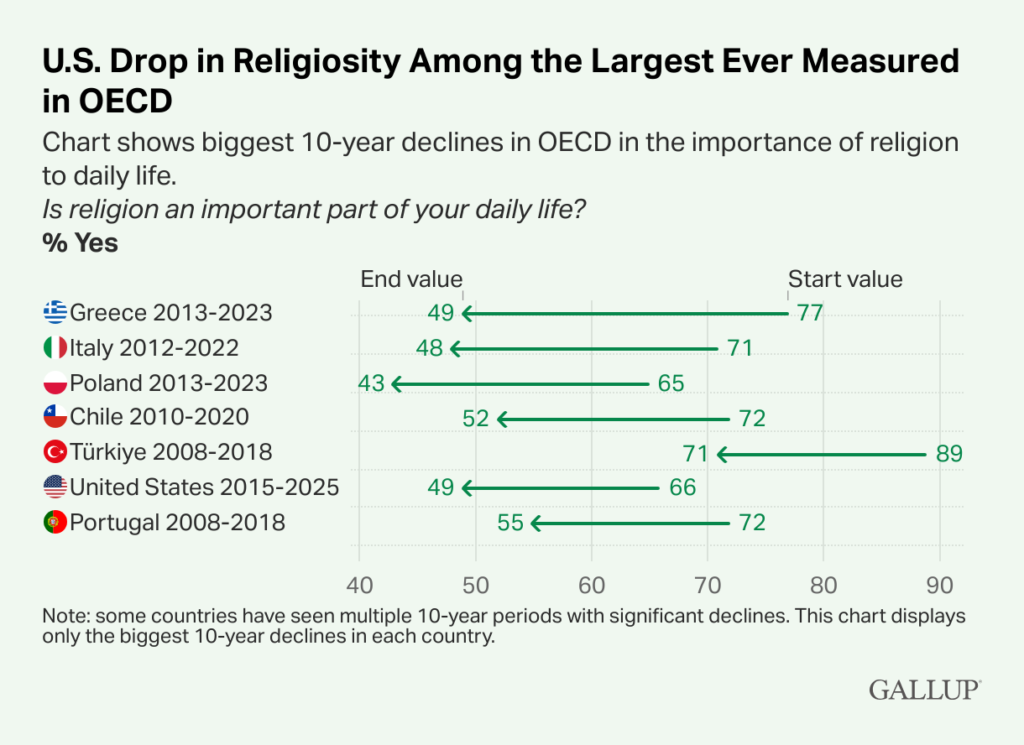
WASHINGTON, D.C. — The 17-point drop in the percentage of U.S. adults who say religion is an important part of their daily life — from 66% in 2015 to 49% today — ranks among the largest Gallup has recorded in any country over any 10-year period since 2007.
About half of Americans now say religion is not an important part of their daily life. They remain as divided on the question today as they were last year.
Such large declines in religiosity are rare. Since 2007, only 14 out of more than 160 countries in the World Poll have experienced drops of over 15 percentage points in religious importance over any 10-year period.
Only a small number of mostly wealthy nations have experienced larger losses in religiosity, including Greece from 2013-2023 (28 points), Italy from 2012-2022 (23 points), and Poland from 2013-2023 (22 points). Other countries, including Chile, Türkiye and Portugal, have seen declines similar in magnitude to the U.S. decline.
U.S. Lags Behind Global Median for Religiosity, Closes Gap With OECD
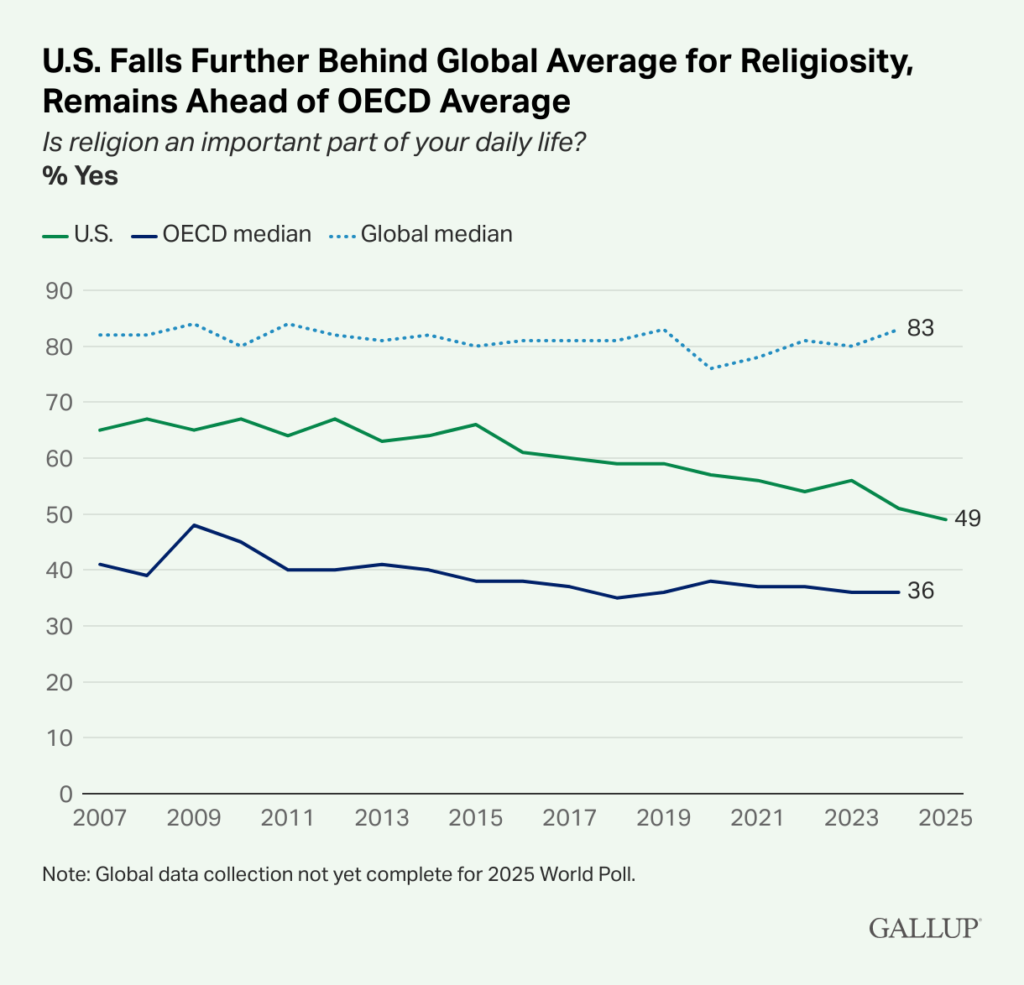
As religiosity has declined in the U.S., the gap between the U.S. and the global median has widened. The global median for religiosity has remained stable for nearly two decades, averaging 81% since 2007 and reaching 83% last year, the most current full-year data available.
At the same time, attitudes in the U.S. are drawing closer to those in other advanced economies. Across the 38 OECD (Organisation for Economic Co-operation and Development) countries in 2024, a median of 36% of adults said religion is important to their daily lives. The gap between the U.S. and the median for these countries is now narrower than at any point in Gallup’s trend.
U.S. Now Occupies Unique Spot in Global Religiosity
The long-term decline in religiosity places the U.S. in a unique position on the global religious landscape. Most countries fall into one of four patterns: high religiosity with Christian identity; high religiosity with another religious identity (often Muslim majority, although there are several countries in the Middle East where Gallup does not ask religious identity questions); low religiosity with Christian identity; or low religiosity with no religious identity.
The U.S. no longer fits neatly into any of these categories, having a medium-high Christian identity but middling religiosity. In terms of religious identity, the percentage of Americans now identifying as Christian is similar to those of Western and Northern European countries such as the United Kingdom, Germany, Finland and Denmark, nations with strong Protestant traditions. Yet religion continues to play a larger role in daily life for Americans than for people in those countries.
Conversely, the importance of religion in daily life in the U.S. resembles that of countries such as Argentina, Ireland, Poland and Italy — where Catholicism is more influential — but significantly fewer Americans now identify as Christian compared with those populations.
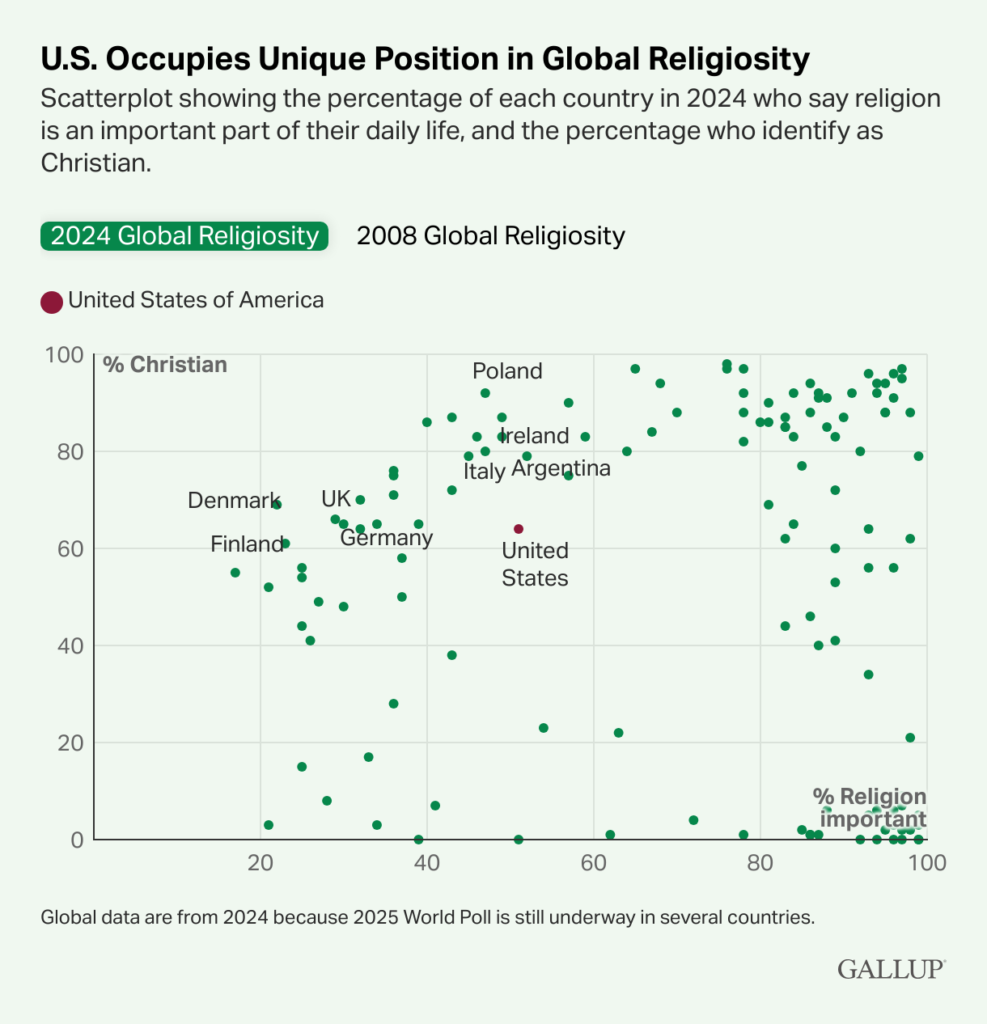
This marks a shift from 2008, when Gallup began consistently tracking people’s religious identity and religion’s role in daily life in most of the world. At that time, the U.S. aligned more closely with countries where religion was widely practiced and most adults identified as Christian.
Bottom Line
The steady decline in U.S. religiosity over the past decade has been evident for years. Fewer Americans identify with a religion, church attendance and membership are declining, and religion holds a less important role in people’s lives than it once did. But this analysis of World Poll data puts the decline in a wider context, showing just how large the shift has been in global terms. Since 2007, few countries have measured larger declines in religiosity.
This means the U.S. lags further behind the global median for religiosity and is drawing closer to the median for other advanced economies. The U.S. increasingly stands as an outlier: less religious than much of the world, but still more devout than most of its economic peers.
Religion’s Sudden Decline. Why It’s Happening and What Comes Next – a new book by the WVSA Founder Ronald Inglehart
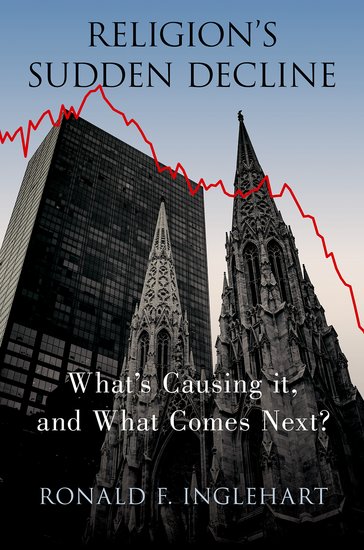
As the 21st century began, religion was spreading rapidly. The collapse of communism had left a psychological vacuum that was being filled with resurgent religion, fundamentalism was a rising political force in the United States, and the 9/11 attacks drew attention to the power of militant Islam. There were claims of a global resurgence of religion.
An analysis of religious trends from 1981 to 2007 in 49 countries containing 60%of the world’s population did not find a global resurgence of religion—most high-income countries were becoming less religious—however, it did show that in 33 of the 49 countries studied, people had become more religious (Norris and Inglehart, 2011). But since 2007, things have changed with surprising speed. From 2007 to 2020, an overwhelming majority (43 out of 49) of these same countries became less religious. This decline in belief is strongest in high-income countries but it is evident across most of the world (Inglehart, 2021).
The most dramatic shift away from religion took place among the American public. For years, the United States had been the key case demonstrating that economic modernization need not produce secularization. But recently, the American public has been moving away from religion along with virtually all other high-income countries—in fact, religiosity has been declining more rapidly in the US than in most other countries.
Several forces are driving this trend but the most powerful one is the waning grip of a set of beliefs closely linked with the imperative of maintaining high birth rates. For many centuries, most societies assigned women the role of producing as many children as possible and discouraged divorce, abortion, homosexuality, contraception, and any other sexual behavior not linked with reproduction. Virtually all major world religions encouraged high fertility because it was necessary, in the world of high infant mortality and low life expectancy that prevailed until recently, for the average woman to produce five to eight children in order to simply replace the population. Religions that didn‘t emphasize these norms gradually disappeared.
A growing number of countries have now attained high life expectancies and drastically reduced infant mortality rates, making these traditional cultural norms no longer necessary. This process didn’t happen overnight. The major world religions had presented pro-fertility norms as absolute moral rules and firmly resisted change. People only slowly give up the familiar beliefs and societal roles they have known since childhood, concerning gender and sexual behavior. But when a society reaches a sufficiently high level of economic and physical security, younger generations grow up taking that security for granted and the norms around fertility recede. Ideas, practices, and laws concerning gender equality, divorce, abortion, and homosexuality are now changing rapidly. Almost all high-income societies have recently reached a tipping point where the balance shifts from pro-fertility norms being dominant, to individual-choice norms being dominant.
Several other factors help explain the waning of religion. In the United States, politics explains part of the decline. Since the 1990s, the Republican Party has sought to win support by adopting conservative Christian positions on same sex marriage, abortion, and other cultural issues. But this appeal to religious voters has had the corollary effect of pushing other voters, especially young liberal ones, away from religion. The uncritical embrace of President Donald Trump by conservative evangelical leaders has accelerated this trend. And the Roman Catholic Church has lost adherents because of its own crises. A 2020 Pew Research Center survey found that an overwhelming majority US adults were aware of recent reports of sexual abuse by Catholic priests, and most of them believed that the abuses were “ongoing problems that are still happening.” Accordingly, many US Catholics said that they have scaled back attendance at mass in response to these reports.
Although some religious conservatives warn that the retreat from faith will lead to a collapse of social cohesion and public morality, the evidence doesn’t support this claim. Surprising as it may seem, countries that are less religious actually tend to be less corrupt and have lower murder rates than religious ones.
Each year, Transparency International published a Corruption Perception Index that ranks public-sector corruption in 180 countries and territories. Is corruption less widespread in religious countries than less religious ones? The answer is an unequivocal “No”—in fact, religious countries actually tend to be more corrupt than secular ones.
This pattern also applies to other crimes, such as murder. Surprising as it may seem, the murder rate is more than ten times as high in the most religious countries as it is in the least religious countries. Some relatively poor countries have low murder rates, but overall, prosperous countries that provide their residents with material and legal security are much safer than poor countries. It’s not that religiosity causes corruption and murder, but that both crime and religiosity tend to be high in poor countries.
In early agrarian societies, when most people lived just above the survival level, religion may have been the most effective way to maintain order and cohesion. But as traditional religiosity declines, an equally strong set of moral norms seems to be emerging to fill the void. Survey evidence from countries containing over 90%of the world’s population indicates that in highly secure and secular countries, people are giving increasingly high priority to self-expression and free choice, with a growing emphasis on human rights, tolerance of outsiders, environmental protection, gender equality, and freedom of speech.
As societies develop from agrarian to industrial to knowledge-based, growing existential security tends to reduce the importance of religion in people’s lives and people become less obedient to traditional religious leaders and institutions. That trend seems likely to continue, but pandemics such as the current one reduce peoples’ sense of existential security. If the pandemic were to endure for decades, or lead to an enduring Great Depression, the theory underlying this article implies that the cultural changes of recent decades would reverse themselves.

That’s conceivable but it would run counter to the trend toward growing prosperity and rising life expectancy that has been spreading throughout the world for the past 500 years. This trend rarely reverses itself for long because it is driven by technological innovation which, once it emerges, usually persists and spreads. If that happens, the long-term outlook is for public morality to be less determined by traditional religions, and increasingly shaped by the culture of growing acceptance of outgroups, gender equality, and environmentalism that has been emerging in recent decades.