
Why NASA wants to own its brilliance once again
Half a century after humans last traveled to the moon, the Artemis II mission’s successful return to Earth earlier this month has reinvigorated public interest in the cosmos.
But even as forward momentum builds, NASA’s workforce is caught in a familiar pendulum swing.
The agency’s federal headcount was decimated last year, with nearly 4,000 people — 20% of its civil servants — taking part in two deferred resignation programs.
NASA’s reliance on contractors grew.
Now, agency Administrator Jared Isaacman has laid plans for a sharp course correction: Rebuilding the federal workforce and reducing reliance on contractors.
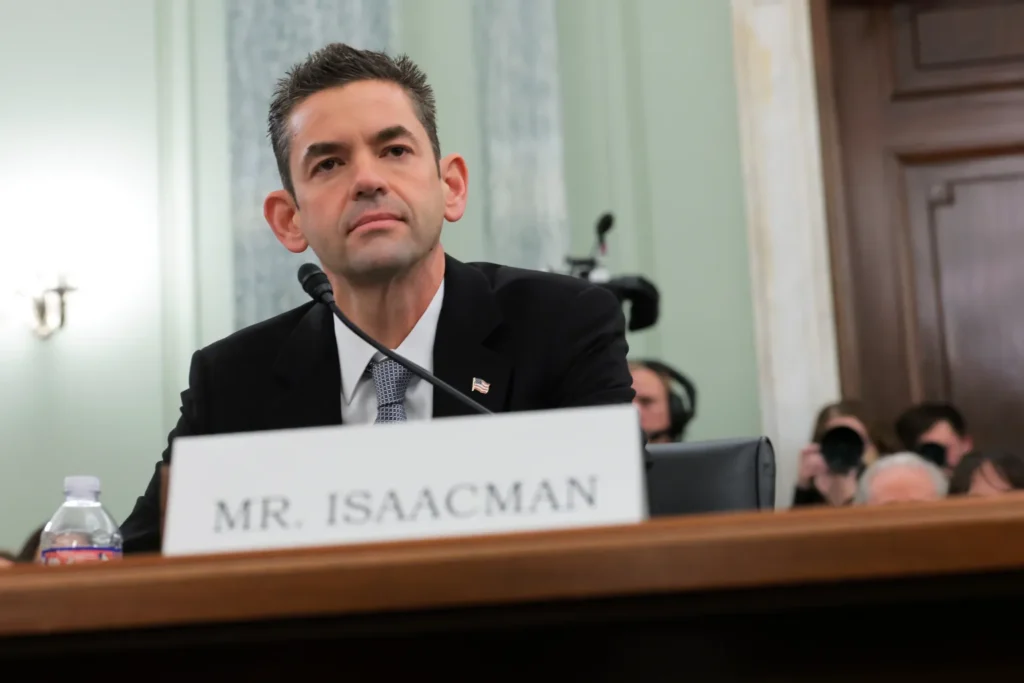
“NASA has outright lost or outsourced many core competencies in engineering and operations that once enabled the agency to undertake the near impossible in air and space,” Isaacman announced in February, noting that contractors now make up 75% of the agency’s workforce.
While some experts say this course correction signals that the agency is moving in the right direction, others say it reflects a familiar cycle.
“From my 60-plus-year association with NASA, I can say that these hiring swings are not new,” said Estella Hernández Gillette, president of the NASA Alumni League for Houston’s Johnson Space Center. “So, I am not really surprised that the pendulum is swinging back the other way — again.”
The exact number of employees to be hired through these initiatives has yet to be determined, but NASA told SAN the agency’s budget allows for the staff additions.
“I don’t think working for the federal government under this environment is in the cards for me,” said one NASA contractor who was laid off amid last year’s cuts and asked for anonymity for fear that speaking out would affect future job prospects. “I would love the opportunity to help leave a liveable world to my child’s generation, but this administration does seem not interested in the future.”
Why is NASA losing so many employees?
Last year, President Donald Trump’s administration announced a massive reduction in the federal workforce recommended by the now-defunct Department of Government Efficiency.
NASA employees were given the option to participate in the government’s offer to take paid leave before exiting their jobs— a decision many agonized over.
“We had been watching federal employees struggle with the decision to take the resignation packages or not for months,” the former contractor told SAN.
In the end, thousands participated, reducing NASA’s federal workforce by one-fifth.
At the same time, Trump proposed a budget reduction of almost 25%— or $6 billion — targeting science programs and other key agency priorities.
The space community fought back, publishing a scathing declaration of dissent signed by more than 350 scientists and current and former NASA employees.
“Major programmatic shifts at NASA must be implemented strategically so that risks are managed carefully,” the letter stated. “Instead, the last six months have seen rapid and wasteful changes which have undermined our mission and caused catastrophic impacts on NASA’s workforce.”
Though the workforce reduction remained in place, Congress ultimately rejected the massive programmatic cuts, passing a final budget for fiscal year 2026 that kept NASA’s funding almost in line with the previous year.
But the damage was already done. As thousands of longtime NASA employees left their jobs, the agency’s institutional knowledge and technical expertise left with them.
What would it take to rebuild NASA’s federal workforce?
Despite Trump’s efforts to shrink the space agency’s federal workforce, Isaacman has pushed for the opposite since his confirmation hearing in December.
At that hearing, Isaacman said reducing NASA’s reliance on contractors, which now made up three-quarters of the staff, is among his top priorities.
“We will never accept a gap in capabilities again,” Isaacman said, “Not with our space station presence in low-earth orbit or our ability to send American astronauts to the moon.”
By March, he had announced two hiring initiatives.
The first would restore NASA’s core competencies by either adding targeted roles to the federal workforce or convert government contractors into civil servants and rebalancing the scales between the two.
“Not only is (relying so heavily on contractors) highly inefficient and leads to continuous program delays, but it’s costly to the tune of nearly $1.4 billion a year in needless expenses,” Isaacman said in February. “That funding could go to more astronauts in space, building a moon base and launching more missions of science and discovery.”
The second, known as “NASA Force,” would create new pathways for private-sector talent to join the agency in two-year stints.
“In theory, it seems good — NASA should have core competencies and have more direct oversight of safety and standards,” said Kenny Evans, a Science, Technology, and Innovation Policy fellow at Rice University’s Baker Institute for Public Policy in Houston and assistant director for innovation policy at Rice Innovation.
Can NASA still attract top talent?
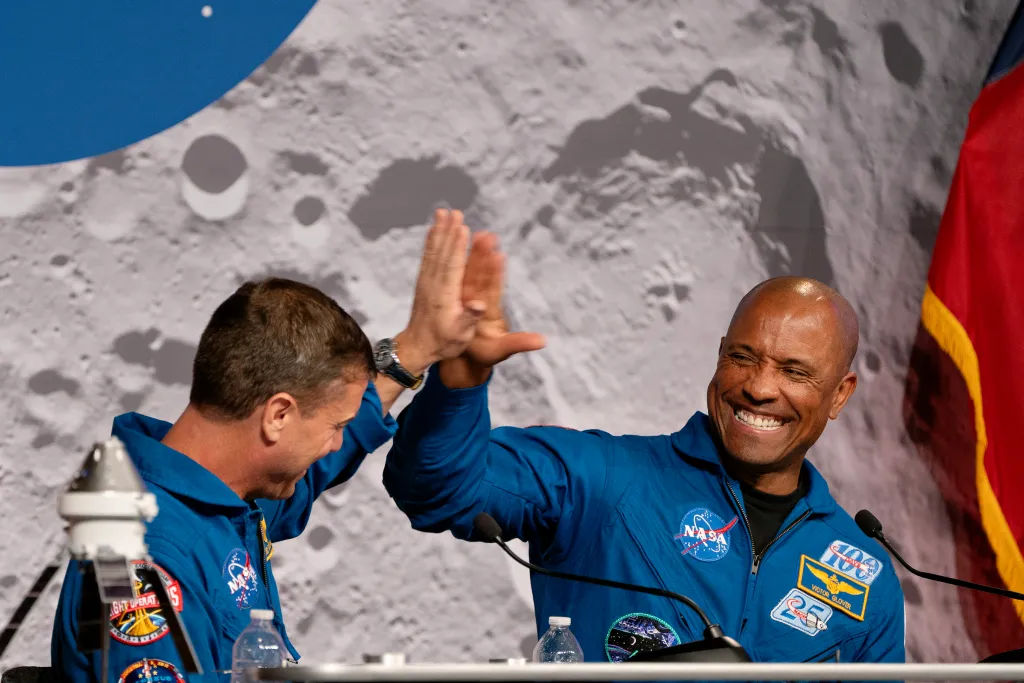
About 27 million people watched Artemis II’s splashdown off the coast of San Diego April 10 after four astronauts successfully traveled to the moon.
It was an important step to fulfilling NASA’s mission of landing on the moon in 2028.
But even as Trump congratulated the astronauts on this historic milestone, his administration has proposed cutting NASA’s budget by 23% — to $18.8 billion from $24.4 billion — in fiscal year 2027.
It’s one reason experts are hesitant to celebrate Isaacman’s plan to hire more federal employees.
While NASA says it has the budget for these hires, Evans is uncertain if the agency will ultimately have the financial capability to do so given what could be coming down the pike.
And even if they do, it remains unclear whether people will want to join an agency so rife with budget cuts and uncertainty.
“We’ll see if they can recruit people,” he said. “All the (federal employees) I know, no one has been safe. It’s been a massive purge.”